
Written by Ilham Indra, Marketing Communication at PT Korea Investment Management Indonesia. Reviewed by Compliance before publication.
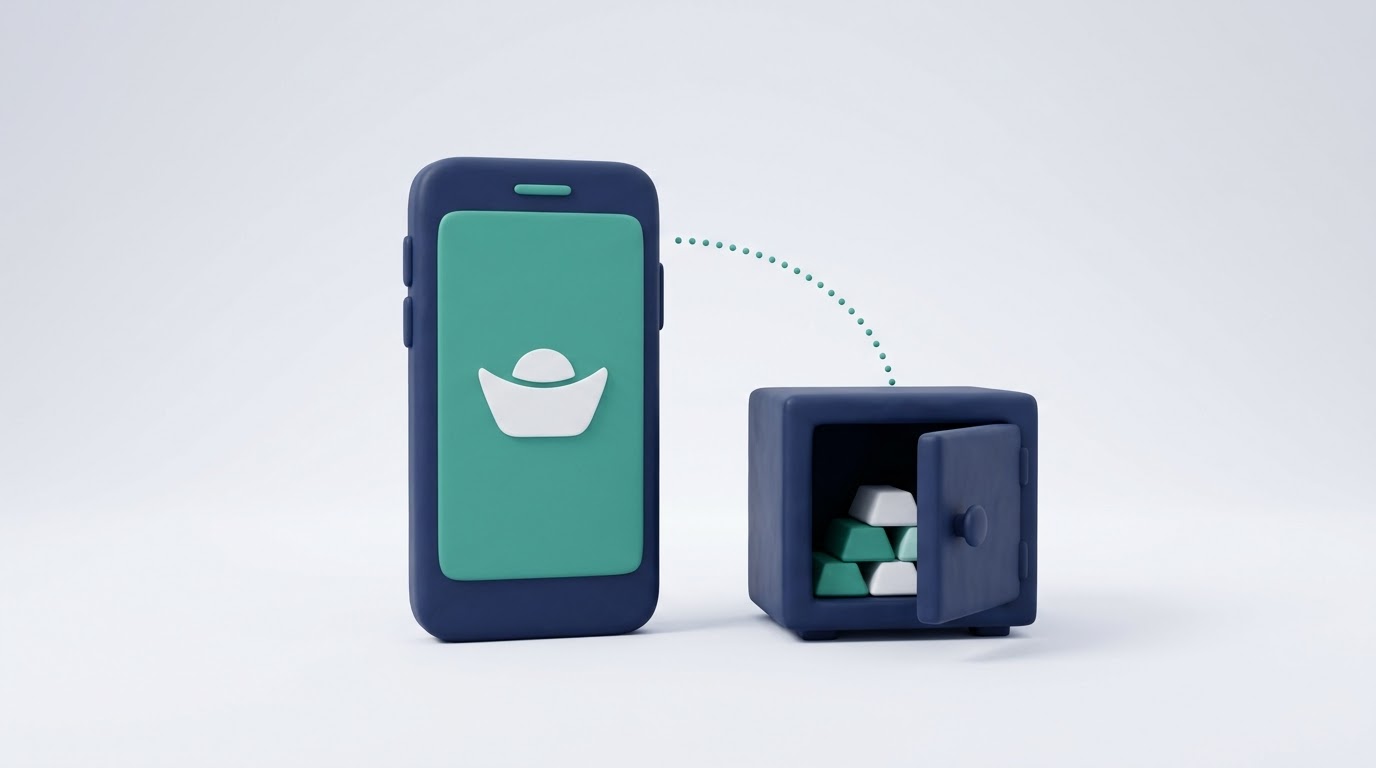
You can buy gold for the price of a cup of coffee and never once hold it. The gold exists, stored in someone else's vault, and what you hold is an electronic record of your ownership. This is digital gold, and it has become one of the most common ways Indonesians first buy into precious metals.
This article explains what digital gold is, how the ownership actually works, where it differs from the bullion you can hold in your hand, and what to check before choosing either one.
What Digital Gold Is
Digital gold is ownership of a quantity of physical gold recorded electronically, where the gold itself is held by a third party and never handed to the owner. The buyer acquires a claim measured in grams or fractions of a gram, not a piece of metal.
The important word is "physical". Digital gold is not virtual gold, and it is not a crypto asset whose value merely tracks the gold price. Behind every recorded gram there is real metal held in a specific vault. What has been digitised is the record of ownership, not the metal.
How Digital Gold Works
Ownership of digital gold usually passes through four roles that are deliberately kept separate.
The operator receives the buyer's money and records how many grams of gold that buyer is entitled to.
The gold supplier provides the physical metal that backs the record.
The gold custodian holds that metal in storage kept separate from the operator's own assets.
The owner can add to, reduce, or — with some operators — withdraw the holding as physical metal once it reaches a mintable quantity.
This separation of roles is what determines how safe a digital gold arrangement really is. When the supplier, the custodian, and the record keeper are different parties checking one another, the damage caused by any one of them failing is more contained.
So the more useful question is not "what is the price today" but "who is holding the gold, and is it separated from the company's own assets".
Four Differences from Physical Gold
Digital gold and bullion are both gold. What differs is how you own it, and each way of owning it carries its own consequences.
Aspect | Physical gold | Digital gold |
|---|---|---|
| Form of ownership | Metal you hold yourself | An electronic record of gold held by someone else |
| Storage | The owner's responsibility and cost | Handled by a custodian, usually for a storage fee |
| Smallest purchase | Limited by mint sizes, typically from 0.5 gram | Can be far smaller, down to fractions of a gram |
| How to cash out | Sold back to a dealer or the issuer | Sold through the same operator |
Neither form is absolutely better. Physical gold gives complete control and does not depend on any platform surviving. Digital gold lowers the entry amount and takes storage off the owner's hands. The right choice depends on which you need more: control, or convenience.
Purity: The Number That Sets the Value
Gold used to back an investment product generally has to meet a defined purity standard. The two references most often used in Indonesia are the national standard at a minimum of 99.9 per cent purity, and the international London Bullion Market Association standard covering gold of at least 99.5 per cent purity that appears on its Good Delivery list.
This is not a technical footnote. Purity determines whether the gold is widely accepted when it is sold, and which reference price it is valued against. Jewellery gold of a lower grade follows a different pricing logic and cannot be treated as equivalent to investment-grade bullion.
Another Route: Gold Through an OJK-Supervised Product
Besides buying bullion or opening a digital gold account, gold can also be held through an investment product whose underlying asset is gold. One such form is a mutual fund structured as a Collective Investment Contract whose Participation Units trade on the Stock Exchange — known as an exchange traded fund, or ETF.
In this structure the fund is managed by an investment manager licensed by the Financial Services Authority, the gold is supplied and stored by appointed parties, and investors' assets are held by a custodian bank that is separate from the investment manager. The supervisory structure differs from an ordinary digital gold account, and that difference is worth understanding before choosing.
A full explanation of how an ETF works is available in our article on exchange traded funds.
What to Check Before You Choose
Who stores the gold, and whether that storage is separated from the operator's own assets.
The purity standard the holding is based on.
Every cost attached, including storage fees and the spread between buying and selling prices.
Which authority supervises the operator, and what licence it holds.
Whether the holding can be withdrawn as physical metal, and at what quantity.
In Closing
Digital gold lowers the barrier to owning gold, but it moves one important thing into someone else's hands: storage. That is why the first things worth checking are not today's price, but who is holding the metal, which standard applies, and who supervises the arrangement.
Before deciding, read the official documents of any product you are considering and make sure you understand both its costs and its risks.
About the Manager
PT Korea Investment Management Indonesia is an investment manager registered with and supervised by the Financial Services Authority under licence number KEP-50/D.04/2019, operating in Indonesia since 2019.
Frequently Asked Questions
Is digital gold real gold?
Yes. Behind every recorded gram there is physical gold held in a specific vault. What has been digitised is the record of ownership, not the metal.
How does digital gold differ from bullion?
The difference is who stores it. With bullion, storage is the owner's responsibility. With digital gold, the metal is held by a third party and the owner holds an electronic record.
Can digital gold be withdrawn as physical metal?
Some operators allow it once the holding reaches a mintable quantity. The terms differ between operators and should be checked in the official documents before buying.
What is the minimum purchase for digital gold?
It is far smaller than a single bar and can be a fraction of a gram. The exact amount is set by each operator.
Is digital gold the same as a gold-backed crypto asset?
No. Digital gold is backed by physical metal actually held in storage, while a gold-backed crypto asset is a different instrument with different mechanics and supervision.
What purity standard applies to investment gold?
Two references are commonly used: the national standard at a minimum of 99.9 per cent purity, and the London Bullion Market Association standard for gold of at least 99.5 per cent on its Good Delivery list.
Next Steps
Read how gold-backed exchange traded funds work in our article What Is an ETF.
See the range of funds managed by PT Korea Investment Management Indonesia on the Products page.